


PRICING tests
Are you ready to market your product and want to determine its optimal price? In addition to psychological pricing, it is crucial to consider several factors related to your product’s maturity and competitive environment to make an informed decision.
KOS offers 2 agile pricing testing approaches to help you determine the optimal price.
1 GABOR & GRANGER (1966)
An indirect approach, which allows determining the PRECISE OPTIMAL PRICE of a product.
→ For each price assumption, the consumer provides an intention to purchase or not.
→ If the response is negative, the consumer provides a reason: too expensive or too cheap.
PRICE ACCEPTANCE DETERMINATION

PURCHASE PRICE EVOLUTION
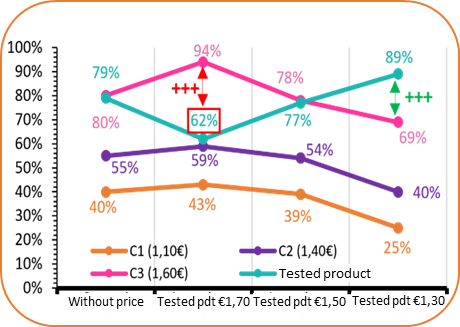
iiiiii We offer a highly sensitive method for OPTIMALLY DETERMINING the price of a product while considering the sensitivity of the target buyers. This approach allows us to:
iiiiii Identify price thresholds to avoid, thus preventing potential loss of buyers.
iiiiii Capture the price range within which the product is credible, avoiding underpricing or overpricing.

KOS has enhanced this approach by considering the competitive landscape, which is essential for reflecting real purchase behavior accurately. By testing various price assumptions, KOS evaluates the impact of a price decrease or increase of the product compared to its competitors and determines the price differentials to adopt.
The purchase intent tests consist of three sequences contextualized by competition:
→ Preliminary sequence: comparison of purchase intent without considering the prices of the tested product and competing products.
→ Main sequence: acceptance or rejection of the product at each price in the series under consideration.
→ Validation sequence: comparison of purchase intent with three price assumptions set by the brand for its commercialization (low price, expected price, high price).
These scenarios allow for the analysis of variations in purchasing behaviors for both the product and its competitors.
This method based on the Gabor & Granger model provides an expanded perspective and allows you to:
- Validate that the optimal price is competitively positioned compared to the competition.
- Opt for a lower price, if necessary, to stimulate a larger market share.
- Simulate market shares for each product based on price variations.
2 PSM (Price Sensitivity Measurement)
Stoetzel-Adam (1958) & Van Westendorp (1976)

An approach that directly asks the consumer to determine the THRESHOLDS that define the ACCEPTABILITY ZONE of a product’s price. Data collection is done through 4 sequential questions:
→ Above what price is the product considered too expensive? (at this price, the consumer does not buy it).
→ Below what price is the product considered too cheap? (which would raise doubts about its quality).
→ Above what price is the product considered expensive?
→ Below what price is the product considered cheap?
→ An acceptable price range is determined

 The accepted price range is the one where the purchase is not rejected due to the price and where most buyers are found. The proposed price should fall within this range.
iiiii The optimal high and low prices correspond to the prices that result in the fewest rejections. The narrower the gap between these prices, the more sensitive the product is to price variations.
→ This method is particularly suitable when the product is a disruptive innovation, and the competitive context is underdeveloped or non-existent. However, this approach can overestimate price sensitivity and result in a very wide price range. To mitigate this effect and obtain a more precise range, KOS Research has adapted the method by considering the context of a similar competitive environment and limiting the range of proposed prices with realistic values for the brand.
Would you like to learn more? Contact us: myhue.joncour@kosresearch.com
+33 (0)6 58 63 94 82